


Get the FAFSA Right
Before you open the application, treat this like any other financial filing: preparation prevents errors. The FAFSA form is long, and the 2025–2026 cycle requires specific data that isn’t always top of mind. Rushing through the setup leads to correction delays that can push your aid award past priority deadlines.
Start by creating your FSA ID at StudentAid.gov. This username and password serve as your legal signature for federal student aid. If you are a dependent student, your parent will also need their own FSA ID. Do not wait until the day you plan to submit to create these accounts, as verification can take up to three days.
Gather your tax information next. The FAFSA uses prior-prior year tax data, meaning you must report income and taxes from two years ago. For the 2025–2026 cycle, this is the 2023 tax year. Having your IRS Data Retrieval Tool ready to go will save you from manual entry errors. If you cannot use the tool, have your tax return and W-2 forms physically in front of you.
Finally, determine your dependency status. Most undergraduates are considered dependent, meaning they must report their parents’ financial information. Independent students only report their own (and their spouse’s, if married) data. Misclassifying your status is a common early mistake that requires a costly correction later. Check the dependency questions on the Federal Student Aid site to be sure.
Work through the steps
Submitting the 2026 FAFSA is less about writing an essay and more about data entry. The new streamlined form is shorter, but the information required hasn't changed. You need your Social Security number, federal tax returns, and records of untaxed income. If you are a dependent student, your parents must provide the same financial details.
Treat this process like filing taxes: accuracy matters more than speed. A single typo in a Social Security number or bank routing number can delay your aid package by weeks. Use the IRS Data Retrieval Tool (DRT) whenever possible. This feature pulls tax data directly from the IRS into your FAFSA, eliminating manual entry errors and reducing the likelihood of being selected for verification.
Create your FSA ID
You and your parents (if you are a dependent student) need an FSA ID to sign the form electronically. This ID acts as your legal signature. Create it at least three days before you plan to start. Account creation involves identity verification, which can take time if you have limited digital history or if you need to verify your identity through alternative methods.
Gather financial documents
Have your tax returns and bank statements ready. For the 2026-27 FAFSA, you will report income from the 2024 tax year. If you or your parents have received untaxed income, such as child support or workers' compensation, have those records organized. You do not need to upload these documents to the FAFSA form itself, but you must have the numbers available to enter them accurately.
Complete the FAFSA form
Log in to studentaid.gov and start your application. The form is divided into sections: student demographics, dependency status, school selection, and financial information. Enter your data carefully. Double-check the FSA IDs of your parents if they are helping you. If you make a mistake, you can correct it later, but corrections can take up to three days to process.
Review and submit
Before submitting, review every section. Check your school codes to ensure your aid is sent to the right places. You can list up to 20 schools on the FAFSA. After submitting, you will receive a confirmation email. Save this email and your Student Aid Index (SAI) number. Your SAI is the number colleges use to determine your eligibility for aid.
Check your status
Log in to your FAFSA account to check your status. It will move from "Submitted" to "Processed" once the Department of Education reviews your data. If you are selected for verification, you may need to submit additional documents. Respond to these requests promptly to avoid delays in receiving your financial aid offer.
Create your FSA ID at least three days before starting. You and your parents (if dependent) need one. This ID is your legal signature.
Collect 2024 tax returns, bank statements, and records of untaxed income. Use the IRS Data Retrieval Tool to avoid manual entry errors.
Enter data carefully. List up to 20 schools. Double-check all entries, especially SSNs and bank routing numbers.
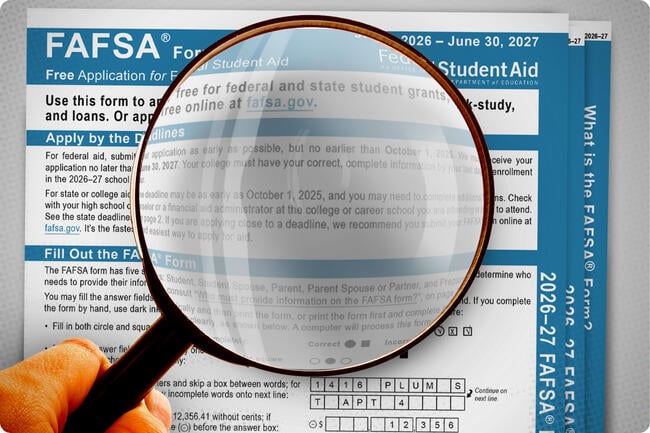
Review every section. Submit the form and save your confirmation email and Student Aid Index (SAI) number.
Monitor your status on studentaid.gov. Respond quickly to any verification requests to avoid delays in aid.
Fix common mistakes
The FAFSA process is less about complexity and more about precision. A single typo or misinterpreted field can shift your Expected Family Contribution (EFC) calculation, directly impacting your loan eligibility and grant amounts. Many applicants treat the form as a bureaucratic hurdle rather than a financial document, leading to avoidable errors that cost thousands in missed aid.
Incorrect Dependency Status
Dependency status determines whose financial information you must report. Most students are considered dependent, meaning they must include their parents’ income and assets. However, students who are 24 or older, married, veterans, or have legal dependents are independent. Misclassifying yourself here is the most frequent and costly error. If you are independent but mark yourself as dependent, you will be asked for parental data you do not have, causing submission failures. Conversely, marking yourself as dependent when you are independent ignores your spouse’s or children’s financial reality, skewing your aid offer.
Mixing Up Tax Years
The FAFSA uses prior-prior year tax data. For the 2026–2027 award year, you will report income from 2024. This change was designed to simplify the process by allowing students to use completed tax returns rather than estimates. However, applicants often default to their most recent tax year (2025) out of habit. If you file your 2025 taxes after submitting the FAFSA, you may need to update your application later. It is critical to locate your 2024 IRS tax transcript or return before starting, rather than guessing based on current-year earnings.
Ignoring the FSA ID
Every student and parent required on the form must have an FSA ID. This digital signature is used to log in to Federal Student Aid websites and sign the form legally. A common mistake is creating an FSA ID for only the student, leaving parents unable to sign their section. This stalls the entire application. Additionally, if you recently changed your name, your FSA ID must reflect that change exactly. Mismatches between your Social Security number, name, and date of record in the FSA ID system will trigger verification holds, delaying your aid package by weeks.
Fafsa: what to check next
Before submitting your 2026 FAFSA, clear these common hurdles. Accurate answers determine your eligibility for federal grants, work-study, and low-interest loans.
Double-check your dependency status and consent signatures. Errors here delay your financial aid package or disqualify you from federal support entirely.
No comments yet. Be the first to share your thoughts!