


Get your FAFSA right
Before you open the FAFSA form, gathering the correct documents prevents errors that delay your financial aid package. The application is strict about data matching; if your Social Security number or name does not match federal records exactly, the system will reject your submission. Treat this preparation phase like assembling a tool kit. You need the right items before you start the work.
First, ensure you have a valid Federal Student Aid ID (FSA ID) for both the student and the parent, if applicable. This ID serves as your legal electronic signature. Without it, you cannot sign or submit the form. If you have forgotten your password or username, reset it at least three days before your planned submission date. The Department of Education requires this lead time to verify identity changes.
Next, collect your financial records. For the 2026–27 award year, you will need your (and your parents’ if you are a dependent student) most recent federal tax information. The FAFSA uses the Direct Data Exchange to pull tax data directly from the IRS, so having your IRS login ready is essential. You also need records of untaxed income, such as child support received or worker’s compensation, and a list of the colleges you plan to attend. You can list up to 20 schools initially and add more later if needed.
Work through the steps
Completing the FAFSA is less about speed and more about accuracy. The 2026-27 form has streamlined some questions, but missing a detail can delay your aid offer or reduce your loan eligibility. Follow this sequence to get it right the first time.
You need an FSA ID to sign your form electronically. If you already have one, log in. If not, create it at fsaid.ed.gov. The ID includes a username and password, plus a security code sent to your email or phone. You can use your FSA ID to sign the FAFSA and view your status.
Before you start, collect your Social Security number, driver’s license number, and federal tax information. If you’re a dependent student, you’ll also need your parents’ financial data. The IRS Data Retrieval Tool (DRT) can pull your tax information directly, which is the fastest and most accurate way to fill out the financial sections.
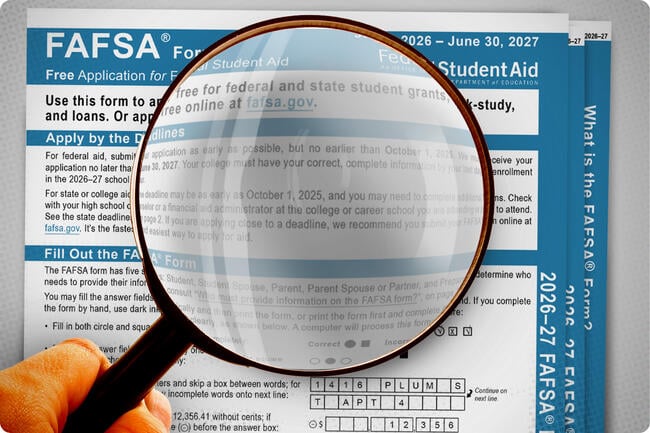
Log in to fafsa.gov and start your application. Answer the questions about your identity, residency, and educational intent. For the financial sections, use the DRT if possible. Double-check that you’ve selected the correct tax year. Errors here are the most common reason for form rejection.

Take your time to review every page. Look for red flags or missing information. Once you’re satisfied, sign the form using your FSA ID. If you’re a dependent student, one of your parents must also sign with their own FSA ID. Without both signatures, your application is incomplete.

After signing, submit the form. You’ll receive a confirmation email. Log back into fafsa.gov after 3-5 business days to check your status. It should change to “Submitted.” If it says “Processed,” you’ll see your Student Aid Index (SAI) and any corrections needed. If it’s “Rejected,” fix the errors immediately.
-
FSA ID created and verified
-
Tax returns and W-2s ready
-
School codes for all colleges listed
-
Financial information accurate
-
Both student and parent signed
Once submitted, your data is sent to every school you listed. Each college will use your FAFSA data to build a financial aid package. Review these offers carefully to understand your loan options and minimize costs.
Fix common mistakes
Even with the simplified 2026 FAFSA process, small errors can significantly reduce your aid package or delay your file. The most frequent mistakes often happen when students or parents assume the new form works exactly like the old one, or when they skip the final verification steps.
Leaving the form incomplete
Many students start the FAFSA but do not submit it until the very last minute, or they abandon the form after the initial login. The FAFSA now uses the IRS Data Retrieval Tool (DRT) by default for most users, which pulls tax data directly. If you leave the form open without completing the signature and review steps, the application remains "incomplete" and generates no aid eligibility. Always wait for the confirmation page showing your submission ID before closing the browser.
Selecting the wrong academic year
The FAFSA form is named for the year it covers, not the year you start filling it out. For the 2026–2027 academic year (fall 2026 through spring 2027), you must select the "2026–2027 FAFSA Form" option. Selecting the wrong year is a common error that leads to rejected applications or misplaced data. Double-check the academic year label at the top of the form before entering any personal information.
Ignoring the Student Aid Report (SAR)
After submission, you receive a Student Aid Report (SAR) that summarizes your data. Many students ignore this document, assuming it’s just a receipt. The SAR is your proof of submission and contains your Student Aid Index (SAI). Review it immediately for errors. If your name, Social Security number, or citizenship status is incorrect, the SAR will flag it, and you must correct it directly in the FAFSA form. Corrections made after the initial submission can take several days to process.
Missing state and school deadlines
The federal FAFSA deadline is June 30, but states and colleges have much earlier deadlines. Many states use the FAFSA to award grants, which are often first-come, first-served. If you wait until the federal deadline to submit, you may miss out on significant state grant money. Check your state’s higher education agency website and your target colleges’ financial aid pages for specific priority deadlines.
Assuming no tax filing means no DRT
Students or parents who did not file taxes may think they cannot use the DRT. While the DRT is the preferred method, the FAFSA now allows you to manually enter tax data if you didn’t file. However, this increases the chance of errors. If you are not required to file taxes, select the "I didn't and won't file" option and follow the prompts for non-filers. This ensures your data is processed correctly without triggering unnecessary verification requests.
Fafsa: what to check next
Students and parents often pause before submitting because the new form feels different or the deadlines are unclear. The following answers address the most common practical objections to filing the 2026-27 FAFSA.
No comments yet. Be the first to share your thoughts!