
IDR Plans: A Quick Overview
Student loan debt can feel overwhelming after graduation. Income-Driven Repayment (IDR) plans offer a way to make repayment more manageable.
IDR plans calculate your monthly loan payment based on your income and family size, meaning lower payments if you earn less. This aligns repayment with your ability to pay.
The Saving on a Valuable Education (SAVE) plan is the newest IDR option, designed to be the most affordable, especially for lower-income borrowers. IDR plans aim to make student loan repayment manageable with your life.
The SAVE Plan: Details & Eligibility
The Saving on a Valuable Education (SAVE) plan changes how federal student loans are repaid, aiming to lower monthly payments and accelerate forgiveness for borrowers with lower original loan balances.
SAVE calculates discretionary income differently, protecting more of your earnings. It raises the protected income from 150% to 225% of the poverty guideline, leading to lower monthly payments. For example, a single borrower earning $50,000 annually would see a substantial reduction in their calculated discretionary income compared to other IDR plans.
To be eligible for SAVE, you generally need eligible federal student loans, such as Direct Loans and consolidation loans. Parent PLUS loans and Perkins Loans do not qualify directly, though consolidation can make them eligible. Borrowers must also not be in default on their loans.
Not everyone will qualify for SAVE. Private student loans or loans not eligible for federal IDR plans are not an option. If you’ve already consolidated loans, verify that the consolidation loan itself is eligible, as some older ones do not qualify.
Comparing All Current IDR Plans
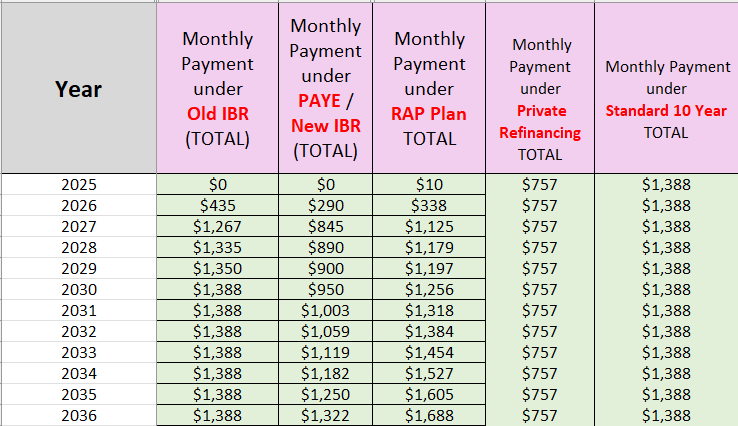
Choosing the right IDR plan depends on your situation. The four main plans are SAVE, Income-Based Repayment (IBR), Income-Contingent Repayment (ICR), and Pay As You Earn (PAYE). Each has its own formula for calculating payments, eligibility, and forgiveness timelines.
The SAVE plan offers the most generous income protection, leading to the lowest payments for many. IBR calculates payments based on 15% of discretionary income (or 10% for new borrowers as of July 1, 2014). PAYE also uses 10% of discretionary income but has stricter eligibility, mainly for new borrowers with a high debt-to-income ratio.
ICR is the most flexible in terms of eligibility, available to almost anyone with eligible federal loans, but it uses a less favorable income calculation, resulting in higher payments. It's the only plan for some loan types. Loan forgiveness timelines range from 20 to 25 years, depending on the plan and original loan amount.
Borrowers with a high debt-to-income ratio and low income may benefit most from SAVE or PAYE. Those with stable, higher incomes might find IBR manageable, while ICR may be the only option if they don’t qualify for others. Consider your current and expected income, and overall debt load when deciding.
- SAVE: Lowest payments, generous income protection, potential for faster forgiveness.
- IBR: 15% (or 10%) of discretionary income, 20-25 year forgiveness.
- PAYE: 10% of discretionary income, stricter eligibility, 20 year forgiveness.
- ICR: Highest payments, most flexible eligibility, 25 year forgiveness.
Income-Driven Repayment (IDR) Plan Comparison - 2026
| Plan Name | Eligible Loan Types | Income Calculation | Payment Caps | Forgiveness Timeline | Pros | Cons |
|---|---|---|---|---|---|---|
| SAVE (Saving on a Valuable Education) | Most federal student loans, including Direct Loans, and some FFEL and Perkins Loans (if consolidated into Direct Loans) | Typically 10% of discretionary income, with income protection allowances. Adjusts with income changes. | Undergraduate: Payments are calculated to be the smallest of these amounts: 5% or 10% of discretionary income, or a fixed payment over 10 or 20 years. | 20 or 25 years, depending on original loan amount and level of education. | • Lowest monthly payments for many borrowers. • Interest subsidy can prevent loan balances from growing. • Income protection allowances are generous. | • Relatively new plan; long-term effects still unfolding. • May pay more interest overall due to longer repayment timeline. |
| IBR (Income-Based Repayment) | Direct Loans, FFEL Loans, and Perkins Loans (if consolidated into Direct Loans). | 15% of discretionary income, or what you would pay on a 10-year standard repayment plan, whichever is less. | Capped at 10-15% of discretionary income. | 20 or 25 years, depending on when you took out the loan. | • Can significantly lower monthly payments. • Loan forgiveness after a set number of years. | • Higher payments than SAVE for many borrowers. • Interest can accrue and capitalize, increasing the total loan cost. |
| ICR (Income-Contingent Repayment) | Direct Loans, FFEL Loans, and Perkins Loans. | 20% of discretionary income or what you would pay on a 12-year fixed repayment plan, whichever is less. | Payments are capped at a fixed amount based on income and family size. | 25 years. | • Available for all federal loan types. • May be a good option if you have a high debt-to-income ratio. | • Generally the most expensive IDR plan. • Higher monthly payments than other IDR plans for many borrowers. |
| PAYE (Pay As You Earn) | Direct Subsidized and Unsubsidized Loans, and Direct PLUS Loans made to students. | 10% of discretionary income. | Payments are capped at 10% of discretionary income. | 20 years. | • Lower payments compared to standard repayment plans. • Loan forgiveness after 20 years. | • Strict eligibility requirements. • Not available for all loan types. |
Illustrative comparison based on the article research brief. Verify current pricing, limits, and product details in the official docs before relying on it.
Using the 2026 IDR Calculator
Need Student Loan offers an Income-Driven Repayment (IDR) calculator to help you estimate potential monthly payments under each plan. It provides a clearer picture of your repayment options.
To use the calculator, input your Adjusted Gross Income (AGI), family size, loan type(s), and total federal student loan debt. Accurate information leads to a more accurate estimate.
For example, a single borrower with an AGI of $60,000 and $40,000 in Direct Loans will see estimated monthly payments under SAVE, IBR, PAYE, and ICR. The calculator shows how different income calculations impact potential payments.
The calculator provides an estimate. Your actual payment is determined by your loan servicer after they verify your income and family size. Re-run calculations if your income or family size changes. This tool is a starting point for informed financial decisions, not a substitute for official information from your servicer.
Forgiveness and Beyond: What to Expect
One of the most appealing aspects of IDR plans is the potential for loan forgiveness. After making consistent payments for a specified period – typically 20 or 25 years – the remaining loan balance is discharged.
Recent changes improve forgiveness timelines for some borrowers. The Biden-Harris administration introduced rules for faster forgiveness for those with lower original loan balances. Borrowers with original balances of $12,000 or less could see forgiveness after 10 years of payments.
undefined forgiveness. The amount forgiven may be considered taxable income by the IRS in the year it’s discharged. This means you could owe income tax on the forgiven amount. I am not a tax professional, and you should consult the IRS website () or a qualified tax advisor for personalized guidance.
Common Mistakes & How to Avoid Them
Applying for and maintaining an IDR plan requires attention to detail. Several common mistakes can derail your progress and lead to unexpected bills.
One frequent error is inaccurate income reporting. Always ensure you’re reporting your Adjusted Gross Income (AGI) correctly, as verified by your tax return. Failing to recertify your income annually is another big mistake. If you don’t recertify, your payments will likely increase significantly.
Choosing the wrong plan is also a common issue. Take the time to compare the plans and select the one that best fits your financial situation. Don’t simply default to the plan your servicer recommends – do your own research!
Here’s a quick checklist to help you prepare: Gather your tax returns, know your loan types and balances, understand your family size, and carefully review the eligibility requirements for each plan.
- Verify your Adjusted Gross Income (AGI).
- Recertify your income annually.
- Compare all IDR plan options.
- Keep accurate records of your payments.
Recertification: Staying on Track
Annual income recertification is absolutely crucial for staying on track with your IDR plan. It’s how your loan servicer updates your monthly payment based on your current financial situation. If you don’t recertify, your payment will revert to the standard repayment amount, which could be significantly higher.
The recertification process is typically done online through your loan servicer’s website. You’ll need to provide documentation of your income, such as your most recent tax return. Missing the recertification deadline can lead to a temporary increase in your payments, and potentially even default if left unaddressed. It’s a step you absolutely shouldn’t overlook.
- FAQ: When do I need to recertify? Annually, by the deadline provided by your servicer.
- FAQ: What happens if I miss the deadline? Your payments will likely increase.
- FAQ: What if my income changes mid-year? Contact your servicer to update your information.

No comments yet. Be the first to share your thoughts!