
New interest rules for SAVE in 2026
The Saving on a Valuable Education (SAVE) plan, introduced as an income-driven repayment (IDR) plan, is undergoing significant updates set to take effect in 2026. These changes primarily revolve around how unpaid interest is handled, offering substantial benefits to many borrowers. Previously, unpaid interest would capitalize – meaning it would be added to the principal balance – but the new rules aim to prevent balances from growing due to interest accrual. This is a big deal for those who consistently make payments lower than the accrued interest.
The Department of Education announced these updates following the Supreme Court’s decision regarding broader student loan forgiveness plans. While that wider forgiveness wasn’t possible, the administration has focused on strengthening existing programs like SAVE to provide more targeted relief. The 2026 changes are a direct result of that commitment, specifically addressing the issue of runaway interest that can plague borrowers in IDR plans.
The rules for student loans change so often it is hard to keep up. Between Supreme Court rulings and new administration policies, most people are just trying to figure out if their balance will actually go down this year. Here is how the 2026 interest changes affect your bill.
These adjustments build upon the initial benefits of the SAVE plan, which already included cutting payments in half for undergraduate loans and reducing the amount of discretionary income considered when calculating payments. The 2026 updates are designed to further alleviate the burden of student debt, particularly for those who have struggled to see their loan balances decrease despite years of repayment.
How income-driven repayment works
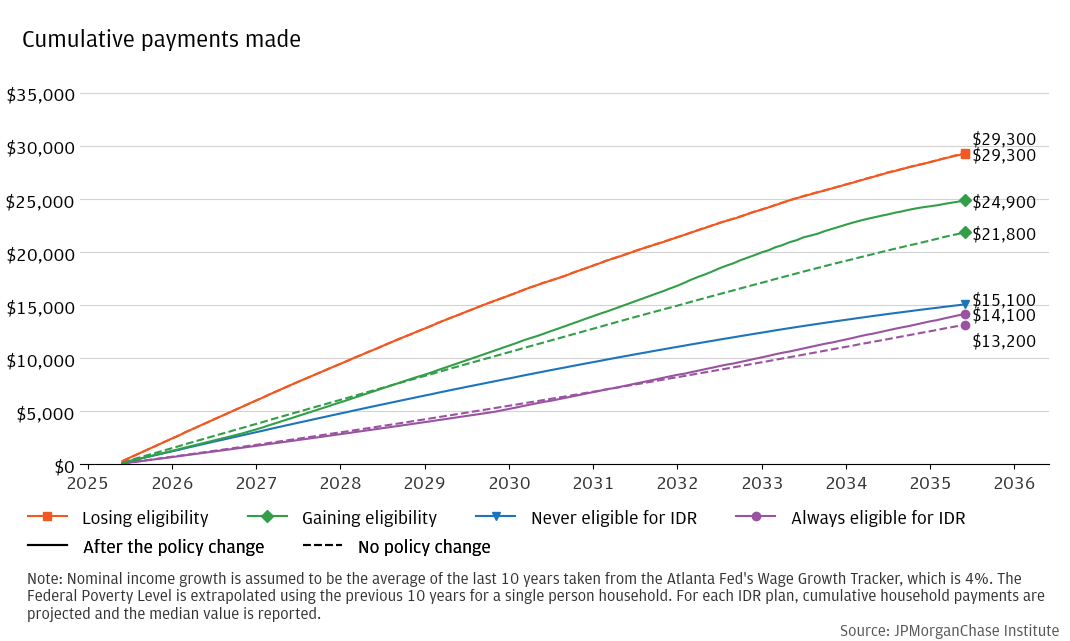
Income-driven repayment (IDR) plans are designed to make federal student loan repayment more manageable. The core principle is simple: your monthly payment is calculated based on your income and family size. This means that if your income is low or your family is large, your monthly payments will be lower than under a standard repayment plan. It’s a safety net for borrowers whose income hasn’t kept pace with their debt.
SAVE is the newest option, but you can still use Income-Based Repayment (IBR), Income-Contingent Repayment (ICR), or Pay As You Earn (PAYE). Each one uses a different percentage of your income to set the monthly bill and has its own timeline for when the remaining balance is wiped away.
IBR generally caps payments at 10-15% of discretionary income, while PAYE caps them at 10%. ICR bases payments on 20% of discretionary income or what you would pay on a 12-year fixed plan, whichever is lower. The SAVE plan, however, takes a different approach, significantly reducing the amount of income considered 'discretionary', leading to lower monthly payments for many borrowers. It is important to remember that the specifics of these plans can change, so regular review is essential.
Choosing the right IDR plan is a personal decision that depends on your individual circumstances. Factors to consider include your income, family size, loan balance, and long-term financial goals. While the SAVE plan is often the most beneficial, it’s crucial to compare all available options to determine which one best fits your needs. The Department of Education provides tools and resources to help you navigate these choices.
A closer look at the SAVE plan
The SAVE plan calculates your monthly payment based on your adjusted gross income (AGI) and family size. Your AGI is your total income minus certain deductions, and it’s found on your federal tax return. The plan then determines your 'discretionary income' – the amount of income available after essential expenses. The essential expenses considered are quite generous under SAVE.
Previously, discretionary income was calculated as the difference between your AGI and 150% of the poverty guideline for your family size. SAVE significantly lowers this to 225% of the poverty guideline. This means more of your income is protected and isn't considered available for loan payments. For example, in 2024, the poverty guideline for a single individual is $15,060. Under the old system, 150% of that is $22,590. Under SAVE, it’s $33,885. That’s a substantial difference.
The plan also offers increased discretionary income protection. Borrowers with undergraduate loans will have payments capped at 5% of their discretionary income, down from the previous 10%. Borrowers with both undergraduate and graduate loans will have payments capped at 10%. This tiered approach recognizes that graduate debt often represents a larger financial burden.
A key feature of the SAVE plan is how it handles unpaid interest. If your calculated monthly payment doesn’t cover the accruing interest, the government will waive the remaining interest, preventing your loan balance from growing. This is a major benefit, as runaway interest is a common problem for borrowers in IDR plans. However, it’s crucial to remember that you must make your full scheduled payment each month to receive this benefit.
Income recertification is a critical part of maintaining your enrollment in the SAVE plan. You’re required to recertify your income annually, providing updated information about your AGI and family size. Failure to recertify can result in your payments increasing or your enrollment being canceled. The Department of Education typically sends reminders before your recertification date, but it’s your responsibility to stay on top of it.
2026 Updates: Capitalization and Interest
Starting in 2026, unpaid interest won't be added to your principal balance anymore. In the past, if your payment didn't cover the interest, that extra cost was tacked onto the loan itself, making the debt grow even while you paid it. The new rules stop that cycle.
Under the old system, interest could capitalize annually, or whenever a borrower left or changed their IDR plan. This meant that the interest accruing over that period would be added to the principal, and future interest calculations would be based on the higher balance. The 2026 changes eliminate this practice altogether. Any unpaid interest will simply be waived, not added to your loan.
Let’s look at a concrete example. Imagine you have a $50,000 loan with a 6% interest rate. You enroll in the SAVE plan and your calculated monthly payment is $200, but the interest accruing each month is $250. Under the old rules, $50 per month in interest would capitalize annually. With the 2026 changes, that $50 won't be added to your principal. It will be forgiven instead.
These changes disproportionately benefit borrowers with lower incomes and larger loan balances. These borrowers are more likely to have payments that don’t cover the full interest accruing, and they are more susceptible to the negative effects of capitalization. By preventing capitalization, the 2026 updates offer a significant path towards eventual loan forgiveness.
It's important to understand that while unpaid interest is waived, you still need to make your scheduled payments. The waived interest doesn’t mean you’re paying less each month; it simply means your loan balance won’t grow due to interest accrual. Consistent, full payments are key to taking advantage of these benefits.
Comparing SAVE to other options
While SAVE is often the most advantageous option, it’s essential to understand how it stacks up against other IDR plans. Income-Based Repayment (IBR) offers forgiveness after 20 or 25 years of qualifying payments, but the payment calculation is less generous than SAVE, particularly for lower-income borrowers. IBR generally caps payments at 10-15% of discretionary income.
Income-Contingent Repayment (ICR) is available to all federal student loan borrowers, regardless of loan type. However, it typically results in higher monthly payments than SAVE or PAYE and has a longer forgiveness timeline. ICR bases payments on 20% of discretionary income or what you’d pay on a 12-year fixed plan, whichever is lower.
Pay As You Earn (PAYE) is another option, but it’s not available to all borrowers. It requires a "financial hardship" to qualify, and it caps payments at 10% of discretionary income. PAYE offers forgiveness after 20 years of qualifying payments. However, the stricter eligibility requirements can make it inaccessible for some.
Here’s a quick comparison table:
The key differences lie in the payment calculations, eligibility requirements, and forgiveness timelines. SAVE offers the lowest payments for many borrowers, especially those with lower incomes and undergraduate loans. It also provides the most generous interest waiver benefits. However, the best plan for you will depend on your specific financial situation.
- SAVE sets payments at 5% to 10% of your income and waives remaining interest so your balance doesn't grow.
- IBR caps payments at 10% or 15% and offers forgiveness after 20 or 25 years depending on when you borrowed.
- ICR: Payments based on 20% of discretionary income or 12-year fixed plan, longer forgiveness timeline.
- PAYE: Payments capped at 10% of discretionary income, requires financial hardship, forgiveness after 20 years.
Income-Driven Repayment (IDR) Plan Comparison - Updates as of Late 2023/Early 2024
| Repayment Plan | Payment Calculation | Income Discretionary Percentage | Eligibility Requirements | Forgiveness Timeline | Interest Subsidy |
|---|---|---|---|---|---|
| SAVE (Saving on a Valuable Education) | Calculated as 10% of discretionary income, with potential to decrease to 5% starting July 2024. Considers family size and income. | 10% (potentially 5% starting July 2024) of discretionary income. | Available to borrowers with eligible federal student loans. Generally, those with Direct Loans are eligible. Borrowers with Parent PLUS loans may be eligible if consolidated into a Direct Consolidation Loan. | 20-25 years for undergraduate loans; 25 years for graduate loans. | Yes, SAVE offers an interest subsidy. If your payment doesn't cover the accruing interest, the remaining interest is waived. |
| IBR (Income-Based Repayment) | Calculated as 10% or 15% of discretionary income, depending on when you took out your loans. | 10% or 15% of discretionary income. | Available to borrowers with eligible federal student loans. Income cannot exceed 150% of the poverty guideline for your family size and state. | 20 or 25 years, depending on loan type and when loans were taken out. | No. |
| ICR (Income-Contingent Repayment) | Calculated as the lesser of 20% of discretionary income or a fixed payment over 12 years. | 20% of discretionary income or fixed 12-year payment. | Available to borrowers with any type of eligible federal student loan, including Direct Loans, FFEL Program Loans, and Perkins Loans. | 25 years. | No. |
| PAYE (Pay As You Earn) | Calculated as 10% of discretionary income. | 10% of discretionary income. | Borrowers must be a new borrower as of October 1, 2007, and have eligible federal student loans. Income cannot exceed 150% of the poverty guideline for your family size and state. | 20 years. | No. |
Illustrative comparison based on the article research brief. Verify current pricing, limits, and product details in the official docs before relying on it.
Who gets the most out of SAVE?
The SAVE plan is particularly beneficial for borrowers with low incomes relative to their debt. If you earn less than you owe in interest each month, the SAVE plan’s interest waiver can prevent your loan balance from spiraling out of control. This is a game-changer for many borrowers who have struggled to make progress on their loans.
Borrowers with high debt-to-income ratios also stand to gain significantly. The lower payment caps and interest waiver can make repayment more manageable, allowing them to stay current on their loans and work towards forgiveness. Those working in public service are also strong candidates, as the SAVE plan can be combined with Public Service Loan Forgiveness (PSLF).
Borrowers with spousal income can sometimes see a complex impact. The SAVE plan considers household income, so a high-earning spouse can increase your monthly payments. However, the generous discretionary income protection can still offset this effect for many borrowers. It’s important to carefully calculate your payments based on your combined income.
Families with multiple children will also benefit from the larger discretionary income allowances under the SAVE plan. The poverty guidelines used to calculate discretionary income increase with family size, meaning a larger family will have a higher income threshold before payments are calculated. For example, a family of four in 2024 has a poverty guideline of $30,000, leading to a higher discretionary income threshold than a single individual.
Common Mistakes and How to Avoid Them
One of the most common mistakes borrowers make is failing to recertify their income annually. As mentioned earlier, you’re required to recertify your income each year to maintain your enrollment in the SAVE plan. Failure to do so can result in your payments increasing or your enrollment being canceled. Set a reminder on your calendar to ensure you don’t miss the deadline.
Providing inaccurate information is another common error. Double-check all the information you enter on your application, including your income, family size, and loan details. Even a small mistake can delay your application or lead to incorrect payment calculations. Be sure your details match what’s on file with the Department of Education.
Misunderstanding eligibility requirements can also be a problem. The SAVE plan has specific eligibility requirements, and not all borrowers will qualify. Make sure you meet all the requirements before applying. If you’re unsure, contact the Federal Student Aid website for clarification.
Finally, don't assume that the SAVE plan is automatically the best option for you. Take the time to compare it to other IDR plans and choose the one that best fits your individual circumstances. Understanding your options is the key to making informed financial decisions.

No comments yet. Be the first to share your thoughts!